The Real Cost

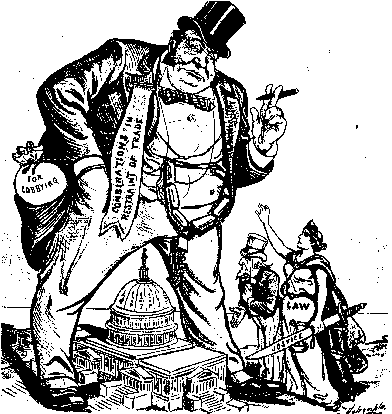
Yes, yes and another yes to George Monbiot’s latest blog post, The Money Gusher, in which Monbiot muses on the real cost of extracting fossil fuels. BP and other fossil fuel corporations just do not prepare adequately  for exigencies such as the Deepwater Horizon spill or global warming, nor do they charge the real price of oil in order to do so. They do, however, ensure that shareholders get their due. The rest of us? Nickle and dime.

Here’s Monbiot:

“Pollution has been defined as a resource in the wrong place. That’s also a pretty good description of the company’s profits. The great plumes of money that have been bursting out of the company’s accounts every year are not BP’s to give away. They consist, in part or in whole, of the externalised costs the company has failed to pay, and which the rest of society must carry.

Does this sound familiar? In the ten years preceding the crash, the banks posted and disposed of stupendous profits. When their risky ventures failed, they discovered that they hadn’t made sufficient provision against future costs, and had to go begging from the state. They had classified their annual surplus as profit and given it to their investors and staff long before it was safe to do so.”

This has been the essence of my criticism of the price of fossil fuel for years — we as consumers have never paid the real cost of fuel because corporations have never been forced to do a true reckoning of the costs of producing fossil fuels. Continue reading

The Hartwell Paper and Capitulation

I haven’t posted for a while. Quite frankly, I’ve been horrified over the BP disaster and have felt that arguing with septics and contrarians is not doing much good in the greater scheme of things.

However, I did stumble across the Hartwell Paper and couldn’t restrain myself.  I shuddered while I read “The Hartwell Paper: A new direction for climate policy after the crash of 2009”. I don’t know what it was — perhaps it was the past few months I’ve spent reading science papers in which empirical evidence is analysed [rather than the puffery of pomo pono types]. Perhaps it’s working in a policy job in which I see just how policy is actually made. When I thought of what the Hartwell Paper advocated, the only word that came to mind again and again was this: capitulation.

Whatever it was, I had a very hard time swallowing the dreck contained within this paper. In fact, there were several shake-the-head and face-palm moments. At one point, I put the paper down and considered if my cartooning skills were up to it for all I could think of was comedy whilst reading the paper. Continue reading

Oxburgh and Organ Grinders

Over at CA, much hay is being made over the comments of Judith Curry about the Oxburgh Report. Curry has become the denialiati and contrarian favorite because she plays right into their hand.

It’s sad, really.

Here’s McIntyre:

The majority of the climate science “community” appear to be so desperate for affection that they’ve proclaimed wind utility chairman Oxburgh’s love to the rooftops merely because of a few sweet nothings whispered in their ears. (Words of love so soft and tender.) Their gratitude is so great that they are willing to overlook the embarrassing brevity of Oxburgh’s report, Oxburgh’s negligible due diligence and failure to address any of the questions that were actually at issue.

Judy Curry has not compromised her standards.

Here’s Curry in an interview over at Collide a Scape:

So in summary, Jones, Briffa et al. can be relieved that they have been vindicated of charges of scientific misconduct.  Even with the deficiencies of the Oxburgh report, I don’t disagree with their conclusion about finding no evidence of scientific misconduct:  I haven’t seen any evidence of plagiarism or fabrication/falsification of data by the CRU scientists.  Sloppy record keeping, cherry picking of data, and inadequate statistical methods do not constitute scientific misconduct, but neither do they inspire confidence in the research product.  Further, the “bad apple” issue is still out there, but this is something that is impossible to assess objectively.  And the behavior of these scientists (sloppy record keeping, dismissal of skeptical critiques, and lack of transparency) has slowed down scientific progress in assessing and improving these very important data sets.  Therefore I have been proposing that we move away from the focus on individual behavior, and shifting focus to issues related to the IPCC assessment process, addressing issues related the availability of data and transparency of the methods, and to improving the temperature data and proxies.  Once these issues are addressed, the “bad apple” issue becomes mostly moot.

What McIntyre and Curry fail to realize or refuse to, is that no one feels a need to respond fully to the so-called ‘critics’ of the CRU because it’s clear they are for the most part just a bunch of contrarians and denialist lackeys who don’t really deserve the time of day let alone a substantive response.

Seriously, looking at what the ‘critics’ have done since the start of their disinformation campaign, one comes up with a big fat ZERO. A few boo-boos that everyone makes from time to time. NO evidence of fraud or deliberate deception or manipulation of the data and thus the temperature record.

So why should the reports respond in detail to these self-styled critics? I don’t believe their project is genuine.

I’m sad to say Curry has become just a pawn of the denialist and contrarians. She is either politically naive or worse. No amount of inquiry is going to satisfy them for they are no out for the truth or facts — they want to deny and delay. Period.

I say, investigate the critics.

Then we might get at something useful.

The Oxburgh Report

The Guardian is reporting that the Oxburgh Inquiry into the methods of the CRU has released its report and has found that the CRU was cleared of malpractice.

The scientists at the centre of the row over the hacked climate emails have been cleared of any deliberate malpractice by the second of three inquiries into their conduct.

The inquiry panel, led by the former chair of the House of Lords science and technology select committee Lord Oxburgh, was commissioned by the University of East Anglia with investigating the research produced by the scientists at its Climatic Research Unit (CRU). Continue reading

Monbiot on the Inquiry

Interesting reading over at Monbiot.com. What’s interesting is that Monbiot, whom I’ve long read with interest although a sometime-skeptical attitude, appears to mirror Mci’s response to the findings of the inquiry.

The MPs were kind to Professor Phil Jones. During its hearings, the Commons Science and Technology Committee didn’t even ask the man at the centre of the hacked climate emails crisis about the central charge he faces: that he urged other scientists to delete material subject to a freedom of information request(1). Last week the committee published its report, and blamed his university for the “culture of non-disclosure” over which Jones presided(2).

Of course, this is not hard to understand: Monbiot after all called for Jones’ firing in the early days after the release of the CRU emails.

From his November post: The Knights Carbonic:

But there are some messages that require no spin to make them look bad. There appears to be evidence here of attempts to prevent scientific data from being released(2,3), and even to destroy material that was subject to a freedom of information request(4).

Worse still, some of the emails suggest efforts to prevent the publication of work by climate sceptics(5,6), or to keep it out of a report by the Intergovernmental Panel on Climate Change(7). I believe that the head of the unit, Phil Jones, should now resign. Some of the data discussed in the emails should be re-analysed.

Calling for Jones to resign suggests Monbiot had already delivered his verdict — Jones was guilty as charged based on the emails. Continue reading

Of Inquiries, Wizards and What’s Behind the Curtain

I happened to see a clip about the Wizard of Oz and remembered the whole wizard hiding behind a curtain scene where the viewer realizes that in reality, the Great and Powerful Oz is nothing more than a rather ordinary older man, harmless really, who just creates this scary facade to make himself appear more powerful than he really is. The threat is all just a lot of smoke and fire and levers and pulleys.

Which got me to thinking about analogies and the like.

Over at CA, McI has an interesting post up. Clearly unsatisfied with the findings of the Parliamentary Inquiry into the CRU Emails, and of course, 3 of the 4 aspects of the Mann inquiry, McI is doing his own inquiry, rehashing some of the issues he feels were inadequately addressed in the UK Inquiry.

What struck me about his post is that it’s clear he spent a great deal of time mining the emails looking for evidence to support his views. What has he come up with?

That Phil Jones and colleagues tried to stymie skeptics’ attempts to get data that was already publicly available or was not subject to release because of confidentiality agreements? He alleges that Jones forced subordinates to make untrue claims (about IPCC procedures and availability of reviewer comments etc. — same ol same ol) and asked subordinates to delete emails relating to AR4. He ponders why the inquiry did not question Jones about his state of mind when he asked underlings to tell untruths and delete documents. Continue reading