Hot off the press: Skeptic game of telephone

H/t to Eli Rabett, such a quick little bunny:

“Fabricated quote used to discredit climate scientists” — in the Independent.

Here’s an excerpt:

For climate sceptics it was a key piece of evidence showing that the scientists behindglobal warming could not be trusted. A quotation by one of the world’s most eminent climate scientists was supposed to demonstrate the depths to which he and his ilk would stoop to create scare stories exaggerating the threat of global warming.

Sir John Houghton, who played a critical role in establishing the Intergovernmental Panel onClimate Change (IPPC), was roundly condemned after it emerged that he was an apparent advocate of scary propaganda to frighten the public into believing the dangers of global warming.

“Unless we announce disasters, no one will listen,” Sir John was supposed to have said in 1994.

The quotation has since become the iconic smoking gun of the climate sceptic community. The words are the very first to appear in the “manual” of climate denialism written by the journalist and arch-sceptic Christopher Booker. They get more than a 100,000 hits on Google, and are wheeled out almost every time a climate sceptic has a point to make, the last occasion being in a Sunday newspaper article last weekend written by the social anthropologist and climate sceptic Benny Peiser.

The trouble is, Sir John Houghton has never said what he is quoted as saying. The words do not appear in his own book on global warming, first published in 1994, despite statements to the contrary. In fact, he denies emphatically that he ever said it at any time, either verbally or in writing.

Very interesting but not very funny…

Here’s Media Watch’s coverage:

Everyone who is anyone in the sceptic firmament has used the quotation. It’s even been quoted in a submission to the British House of Lords.

Yet, amazingly, last week The Independent reported that Sir John Houghton…

…denies emphatically that he ever said it at any time, either verbally or in writing… “I would never say we should hype up the risk of climate disasters in order to get noticed,” he said.

— The Independent, 10th February, 2010

So where did the quote come from?

The Independent and Media Watch have both done computer searches to find the earliest use of the words. And we both came up with the same result: November 2006, in this column in the Sydney Sunday Telegraph…

If this turns out to be what it appears — the skeptic game of telephone — it will be amusing to see all the backtracking and “but but but”s of the skeptic crowd who parrot this quote as proof of AGW alarmism.

I’ll post their apologies for misquoting him all this time.

Yeah, right

First Published Article on Global Warming

Well, here it is — my first published article on global warming: “Mysterious Source of Global Warming Identified”.

I think it worked out pretty well. Comments welcome!

A GHCN Analysis

Over at Open Mind, Tamino has an analysis of GHCN station data that looks quite interesting to this layperson’s eyes. I’m going to start a post on this to examine his analysis and most importantly, the next post which he promises will be a response to skeptics and their criticism of GHCN.

Here’s an excerpt from Prime Meridian:

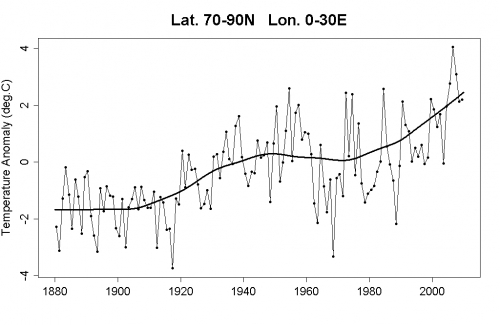
I’ve decided to average the GHCN station data in gridboxes which are 10 deg. latitude tall, and approximately the same width. That makes them 600 nautical miles tall, which is a bit over 1100 km. Within that range, we can expect that all stations which inhabit the same grid box will show correlation with each other. The exception to the “10 deg. tall” rule will be stations north of 70N latitude — instead of defining separate grid boxes for stations north of 80N latitude, I’ll lump them together with the stations north of 70N latitude.

If I wanted to be as precise as possible, I’d use smaller grid boxes and I’d probably weight the average by the distance of a station from the gridbox center. But I’m not aiming for maximum precision; I just want a good solid answer that’s based on a straightforward analysis of the raw data.

Here’s one of his graphs, covering 70 – 90 deg north latitude

This covers the northern latitudes and you can see from Tamino’s graph that the anomaly is quite large for this region of the world — a full 2C.

When I see that graph, I think of Elizabeth Kolbert’s descriptions of thawing permafrost in the Arctic and the Inuit peoples having to abandon their village along the coast because the loss of sea ice allowed the storms to wash away their homes. Continue reading

Phil Jones Q&A at the BBC

The BBC has an article up which includes a Q&A session with Phil Jones of the CRU:

Let’s start with the most important:

E – How confident are you that warming has taken place and that humans are mainly responsible?

I’m 100% confident that the climate has warmed. As to the second question, I would go along with IPCC Chapter 9 – there’s evidence that most of the warming since the 1950s is due to human activity.

Get that, journalists with reading comprehension issues?  100% certain that the climate has warmed and that there’s evidence that most of it is due to human activity.

Here’s a few more:

Q – Let’s talk about the e-mails now: In the e-mails you refer to a “trick” which your critics say suggests you conspired to trick the public? You also mentioned “hiding the decline” (in temperatures). Why did you say these things?

This remark has nothing to do with any “decline” in observed instrumental temperatures. The remark referred to a well-known observation, in a particular set of tree-ring data, that I had used in a figure to represent large-scale summer temperature changes over the last 600 years.

The phrase ‘hide the decline’ was shorthand for providing a composite representation of long-term temperature changes made up of recent instrumental data and earlier tree-ring based evidence, where it was absolutely necessary to remove the incorrect impression given by the tree rings that temperatures between about 1960 and 1999 (when the email was written) were not rising, as our instrumental data clearly showed they were.

This “divergence” is well known in the tree-ring literature and “trick” did not refer to any intention to deceive – but rather “a convenient way of achieving something”, in this case joining the earlier valid part of the tree-ring record with the recent, more reliable instrumental record. Continue reading

Post-Normal Science or [Pseudo] Sort of Science?

This post is just for my own amusement. Feel free to comment but I don’t expect a lot of dialogue since this is just because I’ve been reading the literature on “post-normal” science and am finding it quite enlightening and entertaining at the same time.

So I’m strange like that. 😀

I’d heard about “post-normal science” a while ago on some skeptic blog, but wrote it off as just another attempt to create a sexy new approach to policy studies and not something to waste my time on, but I was wrong. It’s not a waste of my time. 😀 I think it provides me with an insight into a number of issues au courant, including its alignment with climate ‘skeptics’ such as Watts and its popularity with that crowd. Continue reading

A Response to Climate Change Denialism

Here is Richard Sommerville’s response to Climate Change Denialism with a h/t to Rabett Run.

1. The essential findings of mainstream climate change science are firm. This is solid settled science. The world is warming. There are many kinds of evidence: air temperatures, ocean temperatures, melting ice, rising sea levels, and much more. Human activities are the main cause. The warming is not natural. It is not due to the sun, for example. We know this because we can measure the effect of man-made carbon dioxide and it is much stronger than that of the sun, which we also measure.

2. The greenhouse effect is well understood. It is as real as gravity. The foundations of the science are more than 150 years old. Carbon dioxide in the atmosphere traps heat. We know carbon dioxide is increasing because we measure it. We know the increase is due to human activities like burning fossil fuels because we can analyze the chemical evidence for that.

3. Our climate predictions are coming true. Many observed climate changes, like rising sea level, are occurring at the high end of the predicted changes. Some changes, like melting sea ice, are happening faster than the anticipated worst case. Unless mankind takes strong steps to halt and reverse the rapid global increase of fossil fuel use and the other activities that cause climate change, and does so in a very few years, severe climate change is inevitable. Urgent action is needed if global warming is to be limited to moderate levels.

4. The standard skeptical arguments have been refuted many times over. The refutations are on many web sites and in many books. For example, natural climate change like ice ages is irrelevant to the current warming. We know why ice ages come and go. That is due to changes in the Earth’s orbit around the sun, changes that take thousands of years. The warming that is occurring now, over just a few decades, cannot possibly be caused by such slow-acting processes. But it can be caused by man-made changes in the greenhouse effect.

5. Science has its own high standards. It does not work by unqualified people making claims on television or the Internet. It works by scientists doing research and publishing it in carefully reviewed research journals. Other scientists examine the research and repeat it and extend it. Valid results are confirmed, and wrong ones are exposed and abandoned.  Science is self-correcting. People who are not experts, who are not trained and experienced in this field, who do not do research and publish it following standard scientific practice, are not doing science. When they claim that they are the real experts, they are just plain wrong.

6. The leading scientific organizations of the world, like national academies of science and professional scientific societies, have carefully examined the results of climate science and endorsed these results. It is silly to imagine that thousands of climate scientists worldwide are engaged in a massive conspiracy to fool everybody. The first thing that the world needs to do if it is going to confront the challenge of climate change wisely is to learn about what science has discovered and accept it.

The problem of course is that denialists will just deny each point. They will claim he posts no evidence and even if he did, they would claim the evidence was doctored. Denialists are not the proper targets of course. The undecided and the honest skeptic are and perhaps the more objective journalists.

Le sigh.

It is useful though to have this kind of response in one place. I’d like to see some evidence attached to it and responses to anticipated objections to denialists. That would be good to use as a primer for educational purposes, but I’m afraid that climate science is now so discredited due to the CRU emails and related spin and publicity and of course, recent “IPCC Gates”, that it will take some time and more solid evidence for the tide of public opinion to turn.